
Sea Spaghetti is best soaked before use, it is probably still alive even though dried, but soak it in fresh water for a quarter of an hour before use.
You can use the soak water as a stock if you like - it will be a kind of cold water dashi, and quite salty.
Sea spaghetti cooks just like pasta, 7 to 10 mins for young fronds.
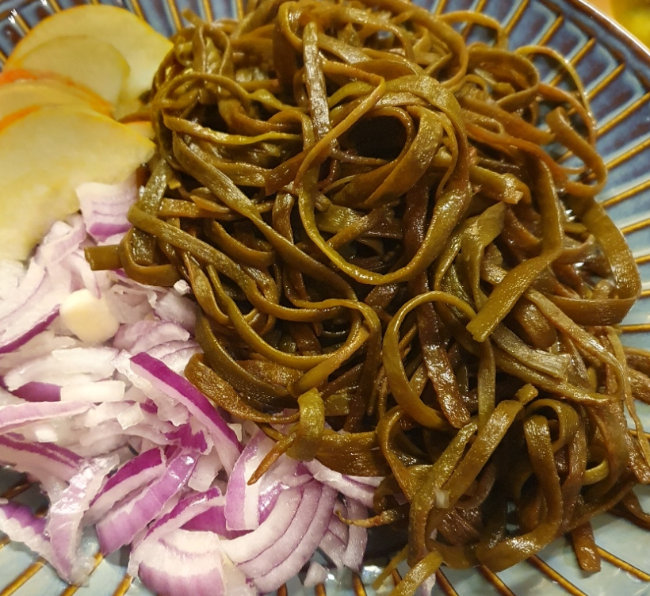
This image is 25g Irish Sea Spaghetti, soaked and cooked as above and served with sliced red onion and apple.
Suggested portion size is 12g (a quarter pack) per person which makes a 50g serving cooked.
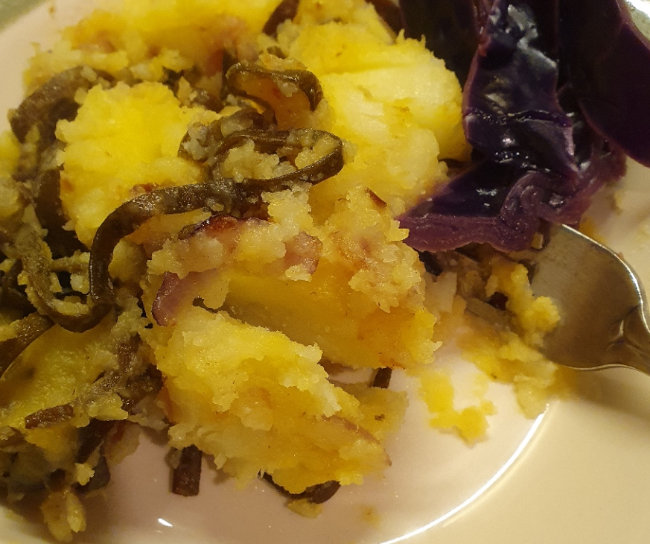
Saute potatoes with sea spaghetti, served with a spoon of Brinjal pickle.
Adding some citrus to the pan when cooking can enhance its flavour.
Try with sliced lemon or lime, or even with oranges.
A 50g pack will make about 125g fresh seaweed when soaked and rehydrated.
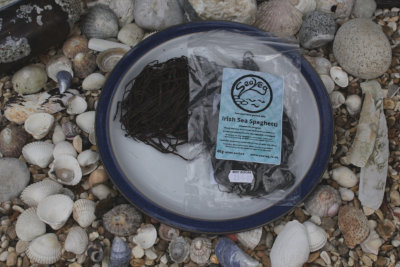
Irish Sea Spaghetti is hand picked from coastal waters of North West Donegal
Noted for its clean sea areas and unspoilt beaches.
Irish Sea Spaghetti is a biannual sea vegetable which grows on rocks which are accessable at low tide.
It can be seem in some old drawings of viking longboats, hanging in the boughs where it was used as a staple on long voyages.
It contains amongst other things vitamin C which made it useful on long sea voyages.
| Nutrition Information
Typical values per 100g | |
|---|---|
| Energy | 745KJ |
| 180Kcal | |
| Fat | 2.7g |
| of which saturates | 0.7 |
| Carbohydrate | 28g |
| of which sugars | 0 |
| Protein | 10g |
| Salt | 10g |
Nutrition data is provided as a guide only
Please note that actual values will vary considerably from those stated which are based on samples taken and analysed by the french seaweed institute at www.ceva.fr